Awakening to Wonder
August 24, 2025
“I am the good shepherd, and I know mine and mine know me.” –John 10:14
Last week, I wrote about the three main tasks of true education at the beginning of this new school year. As we are currently enrolling children and youth in our faith formation programs, I would like to show how these tasks of education correspond to the Catholic Church’s catechetical vision as expressed in the Vatican’s Directory for Catechesis (DFC) and the methodology that we use here at Assumption Parish. Although I will use examples from our Catechesis of the Good Shepherd program for children (CGS), the same principles inform our youth ministry and adult faith formation as well.
First, I would like to speak about the role of our catechists. They are not merely “Sunday School teachers.” The word catechist comes from the Greek word katēkhein which means “to echo down.” The role of the catechist is not to teach their own message, but to “echo” our Catholic faith as it has been given to us in the Bible and the Catechism of the Catholic Church. A good catechist is like a midwife, bringing to healthy fruition the eternal life given in baptism.
Our catechists awaken baptized disciples to wonder and lead them in the discovery of the truth. Jesus said, “I am the way and the truth and the life.” (John 14:6) “At the center of every process of catechesis is the living encounter with Christ. Accordingly, the definitive aim of catechesis is to put people not only in touch but in communion, in intimacy, with Jesus Christ.” (DFC, no. 75) While our catechists spend many hours of catechetical formation, they do not need to become expert theologians, rather they seek to become “experts in the art of accompaniment.” (DFC, no. 113) Their emphasis is always on fostering the relationship between disciples and Jesus. They don’t give rote answers to someone else’s questions but help young disciples to formulate their own questions and seek the answers together in Christ. For example, when a story from scripture is presented in CGS, the catechist invites the children to reflection: “I wonder what Mary (or Joseph or this shepherd) was feeling when Jesus was born?” or “What do you hear God say to you through this work we just performed?”
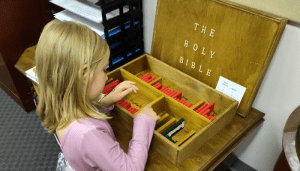
Our catechists demonstrate the connectedness and beauty of God’s creation and God’s plan, facilitating what the bible refers to as knowledge. It would be much easier to have a “Religious Education” program with classrooms, desks, and textbooks. We could try to cram as many Catholic faith facts as possible in an hour into the children’s brains. However, “the encounter with Christ involves the person in their totality: heart, mind, and senses. It does not concern only the mind, but also the body, and above all the heart.” (DFC, no. 76) In CGS, there are no classrooms. Formation spaces are called Atria, and extreme care is taken in the preparing the environment of each atrium. Our Level I (age 3-6) atrium has a miniature altar, tabernacle, baptismal font, liturgical vestments, and much more. The whole child is engaged in formation. In Level II (ages 6-9), the students create a Fettuccia, an extremely long timeline made of ribbon which corresponds to the presentation The History of the Kingdom of God. The young disciples learn “hands on” how all creation and all of history are part of God’s one big plan from the beginning to the end of time, including all people. They are encouraged to contemplate how they are part of God’s plan of love and marvel at all of God’s gifts and how we are called to steward them.
Our catechists aim to shape the character of disciples, conforming their attitudes and behavior to Jesus, whom they have received in baptism and the other sacraments. “The catechetical task of educating the believer to the good life of the Gospel involves the Christian formation of the moral conscience, so that in every circumstance they may listen to the Father’s will in order to discern, under the guidance of the Spirit and in harmony with the law of Christ, the evil to be avoided and the good to be done and putting this into practice with diligent charity.” (DFC, no. 84) A good catechist not only informs the consciences of disciples, teaching right from wrong, but also forms them through putting virtue into practice. CGS catechists spend a good deal of time learning about the moral capacities of children at their various developmental stages.
With the very young children in Level I, self-control of the body and picking up after yourself are emphasized, along with encouragement to consider how to empathetically recognize and honor other children’s work space, materials, and feelings. Level II young disciples are prepared to receive the Sacrament of Reconciliation: learning to take accountability for their sinful choices, ask for forgiveness, and seek to repair damages. In CGS atria, young disciples learn and grow from their successes and challenges in a safe space, always listening to God’s Word and seeking to put it calmly, consistently, and lovingly into practice at their appropriate developmental stages.
Finally, our CGS and youth ministry faith formation programs strive to be a vital partnership with parents. “Believing parents, with their daily example of life, have the most effective capacity to transmit the beauty of the Christian faith to their children . . . the greatest challenge is for mothers and fathers, active participants in catechesis, to overcome the mentality of delegation that is so common, according to which the faith is set aside for specialists in religious education.” (DFC, no. 124) Faith is caught more than it is taught. That is why “catechesis is intrinsically linked with the whole of liturgical and sacramental activity, for it is in the sacraments, especially in the Eucharist, that Christ Jesus works in fullness for the transformation of human beings.” (DFC, no. 96) Holistic faith formation becomes fruitful and effective when households participate in Mass and parish faith formation sessions every week and live Catholic liturgical traditions in their home (regular family prayer together, Advent wreaths and calendars, Christmas manger scenes, Lent Rice Bowl almsgiving, celebrate baptism anniversaries and patron saint feast days, etc.)
Rooted in the Sacraments, especially the Sacraments of Initiation—Baptism, Confirmation, and Eucharist—we are called to nourish the mystery of life of faith that we have received by the Grace of Jesus Christ. In other words, Christian faith formation is a life-long dialogue, journey, and responsibility. These Sacraments also call us to become evangelizers (catechists) ourselves: in our families and homes, in our parish church, in our neighborhoods and community. Together, let us grow in the full stature of Christ the Good Shepherd this school year!