Sacred Music: Touching the Heart and Shaping the Soul
By John Graveline, Director of Parish Life
November 23, 2025
“Praise [God] with sound of trumpet, praise him with lute and harp. Praise him with timbrel and dance, praise him with strings and pipes. O praise him with resounding cymbals, praise him with clashing of cymbals. Let everything that lives and breathes give praise to the Lord.”
–Psalm 150:3-6
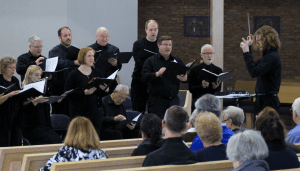
Today we celebrate the last Sunday of the liturgical year, the Solemnity of Our Lord Jesus Christ, King of the Universe. We still have a little over a month of this Jubilee Year of 2025. This year has been marked by Jubilee celebrations almost every week asking us to celebrate, consider the meaning, and raise in prayer various aspects of human life and Church life. This week, we celebrate the Jubilee of Choirs. You may remember that in February we celebrated the Jubilee of Artists and that in May we celebrated the Jubilee of Musical Bands. What makes this Jubilee different?
Vatican II’s document on the liturgy which changed so much about the ways Catholics worship and celebrate the sacraments devoted an entire chapter to sacred music. It begins the chapter by stating, “the musical tradition of the universal Church is a treasure of inestimable value, greater even of that of any other art. The main reason for this pre-eminence is that, as a combination of sacred music and words, it forms a necessary or integral part of the solemn liturgy.” The document also informs us of the twofold purpose of sacred music: to give glory to God and to form us in holiness. (Constitution on the Sacred Liturgy, no. 112)
The musical treasures of sacred music, both ancient and new, have nourished the faith of generations. Vatican II reminded us that in Roman Catholicism Gregorian chant is especially suited to the liturgy. We keep this tradition alive at Assumption by using chant settings for the songs at Mass that never change (Holy Holy Holy, Lamb of God, etc.) during Advent and Lent. Our music ministers have also begun to chant the Entrance and Communion Antiphons before the Opening and Communion Songs. Polyphonic music is also esteemed by the Church, but in the Renaissance period it was considered too influenced by the popular music of its time. The most well-known composer of that era is Giovanni de Palestrina. Earlier this year, some churches celebrated the 600th anniversary of his birth by using his music at Mass and hosting special concerts. Likewise, the Classical-music period gave us beautiful sacred music. We have tried to keep that tradition alive through our recent community concerts, including this Christmas’ ecumenical outreach offering of Handel’s Messiah. The beautiful tradition of sacred hymnody, a staple of our parish’s repertoire, blended profound original poetry to music meant to be accessible for the entire assembly to sing. In the post-Vatican II era (1965-present), we have seen an increase in sacred music composed to nourish the faith of the people of our time. Many of these have been rooted in cultural and ethnic traditions (Spirituals), folk music, popular music (contemporary Christian praise & worship), and reincorporation and reimagining of the music of the musical forms of previous eras. While Vatican II reaffirmed the traditional importance of the organ in liturgical worship, it “approves of all forms of true art which have the requisite qualities and admits them into divine worship.” All instruments and musical art that can glorify God and sanctify us is appropriate. We see this expressed eloquently in the Psalms.
The unavoidable question when considering any contemplation of music is the question of taste. While everyone enjoys music, people’s taste in what they consider edifying music can be wide and deep. Some parishes have tried to address this issue with “themed” Masses each week: early Sunday “traditional” Mass, Sunday evening youth or “folk” Masses, etc. I’m personally not a fan of this solution. I think that it is best for parishes to offer a wide selection of music at every Mass, utilizing the treasures of Church’s musical traditions, both ancient and contemporary. Not everything will appeal to everyone, but there should be something to assist everyone to deeper, prayerful connection to the liturgical action while at the same time everyone to grow a little beyond their personal comfort zone, which is one of the most valuable things about living and worshiping in community.
Another issue is that, objectively, the music and words of sacred music can vary greatly in musical or theological quality. This seems especially true of contemporary sacred music. However, we recognize that there was a lot of monotonous, boring chant and polyphony when those genres were being developed. Anyone who has watched Amadeus has an insight that there were many court composers in the classical form whose music was pedestrian (there was only one Mozart!). Many hymns were maudlin, either in their poetry or music. The “good stuff” has tended to stand the test of time. The compositions of those eras that we still sing tend to be the “best of the best.” Time has begun to sort out which contemporary worship music will endure, but we are still living through the present era. The cream will eventually rise to the top.
By far, the greatest emphasis that Vatican II expressed is that everything in the liturgy facilitate the full and active participation of the faithful. Good liturgy is liturgy in which we grow in deeper communion with God and neighbor in love. When we are gathered together for Mass, we enter into the mystery of God’s work of redemption through our attention (listening carefully to the Scriptures and liturgical prayers), our strong vocal responses and intentional bodily gestures, and through our singing. The point is not to be great at singing, but to praise our great God though the gift of sacred music. If you aren’t familiar with the song or melody, hum along while contemplating the words until you become comfortable. Sacred music is not a liturgical “time out” but an integral part of the liturgy where we will harvest the spiritual fruit to the degree that we intentionally and actively cultivate the seed of faith in our hearts. Nothing touches the heart and shapes the soul the way that music does.
I would like to thank Jim Renfer, Fr. Rick, and all our choir, musicians, and music ministry volunteers for enriching our parish liturgies with beauty and spirituality by sharing your talents! Since this Sunday is the Global Celebration of Young People and our youth are returning from participating in the National Catholic Youth Conference in Indianapolis, I want to especially thank our younger parishioners who share their musical gifts with the parish community! This Saturday, we also celebrate the Memorial of St. Cecila, patroness of music and musicians. Under her patronage and intercession, may we as a parish always “go rejoicing to the house of the Lord!”
John