The Hour of Glory
By John Graveline, Director of Parish Life
March 29, 2026
“Jesus answered them, ‘The hour has come for the Son of Man to be glorified. Amen, amen, I say to you, unless a grain of wheat falls to the ground and dies, it remains just a grain of wheat; but if it dies, it produces much fruit.’”
John 12:23-24
Glorians, Grace, and Glorification
Today we begin our annual liturgical commemoration of Holy Week. It is the week where death and life will contend “in that combat stupendous: the Prince of life, who died, reigns immortal.” Jesus refers to his crucifixion as participating in his “hour” of glory. It is easy for us to see how his resurrection reveals his glory. But his brutal, violent, sinful death? Where is the glory to be found in that?
I recently heard an interview on the radio with Terry Tempest Williams, a conservationist and author of the book The Glorians: Visitations from the Holy Ordinary. She defines a glorian as “a moment where attention is fused, it comes unearned, unbidden, grace” where chronological time falls away and we are present and connected to something bigger than ourselves. What struck me was when she referred to her mother’s cancer as a glorian. When the interviewer incredulously asked her about this, Williams replied, “the glorian doesn’t have to be all light, beauty, and wonder . . . it brought us to our knees, focused attention, giving us the strength and the courage not to look away . . . it’s an awakening.”
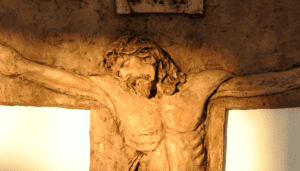
Jesus refers to his cross as part of his glorification because it is the pre-eminent expression of the self-emptying love what we hear this weekend from the Letter to the Philippians. The eternal Son of God became one of us purely for the sake of his love for us. “He worked with human hands, he thought with a human mind. He acted with a human will, and with a human heart he loved.” (Vatican II, Constitution on the Church in the Modern World, no. 22) When the Son took on our wounded human nature, he also took on a death like ours. God who is Love (1 John 4:8) holds nothing back, is willing to suffer anything for the sake of God’s passionate love for us. God’s love is a complete self-gift. The cruelty of this world brought Jesus (and brings us) to our knees, but crucifixion of Jesus is the ultimate revelation of the unconditional love that is God’s eternal glory if we have the courage to stand at the foot of his cross and not look away.
“Were you there when they crucified my Lord? Were you there when they crucified my Lord? Oh! Sometimes it causes me to tremble! tremble! tremble! Were you there when they crucified my Lord?”
Holy Week: A Week Like No Other
I believe that to experience the liturgies of Holy Week are a glorian, if not the glorian from which all others derive their meaning. They capture our attention, they encourage us to leave chronological time at the church doors, bring us to our knees and lift us to the heights, and lead us to contemplate the meaning of our life, sufferings, deaths, and resurrections in the light of Jesus’ Paschal Mystery. As Archbishop J. Augustine DiNoia, my theology professor, has written, “These celebrations invite us to participate not just spiritually but physically in the events of the passion, death, and resurrection of Christ . . . not just as onlookers but as actors in the events commemorated. We are there—albeit liturgically and sacramentally—but nonetheless really. This is the special grace of the Holy Week liturgies; so profoundly to enter into mysteries of Christ’s passion as to receive their benefits in the depths of our hearts.” (Grace in Season, p. 61-62) This is all the more true during the days of the Sacred Paschal Triduum (evening Holy Thursday through sundown Easter Sunday). The Triduum liturgy is one great act of liturgical worship in which we enter sacramentally into Christ’s Pascal Mystery, which is “the unique event of human history which does not pass away . . . all other historical events happen once, and then pass away, swallowed up in the past . . . the event of the Cross and Resurrection abides and draws everything toward life.” (Catechism of the Catholic Church, no. 1085)
Being present in person and fully participating in the liturgies of Holy Week can be life-transformative, especially for school-age children and young people. If we open our hearts to the Grace offered during this sacred time, the liturgies of Holy Week are unlike any other week in the church liturgical year. If it has not been your practice to participate in these liturgies, I encourage you to plan to attend them, listening and noticing their riches. (You can find our schedule and more information here.) If you already know the spiritual power of the liturgies of Holy Week, invite someone (perhaps who has been away from church for a while) to accompany you. We will be blessed to welcome Fr. Jim Bessert, formerly of the Diocese of Saginaw Office of Liturgy, to present to us on the topic of “Fully Experiencing Holy Week Liturgy” this Monday evening at 6:30. This is a special opportunity to learn how to better see, listen, touch, smell, and taste the spiritual fruit available to us during this unique week.
The more that we make ourselves available to God with open hearts, the more God will fill us with the Grace of Eternal Life, overflowing through us to bless our world so desperate for meaning, light, peace, hope, and everlasting love.
John