Orientalium Ecclesiarum: Eastern Rite Catholic Churches
By John Graveline, Director of Parish Life
July 26, 2026
“Every day in the East the sun of hope rises again, the light that restores life to the human race. It is from the East, according to a lovely image, that our Savior will come again.”
Pope St. John Paul II, The Light of the East, no. 28
As we continue to reflect upon the documents of Vatican II at the beginning of the Year of the Holy Spirit, this week we will consider the question “How are Latin Rite Catholics and Eastern Rite Catholics related to each other?” by exploring Vatican II’s Decree on the Catholic Eastern Churches (also known by its Latin title Orientalium Ecclesiarum). This document should be read in the light of the Constitution on the Church (Lumen Gentium) that we read at the beginning of the summer because everything in that document applies equally to Catholics who belong to any ritual church.
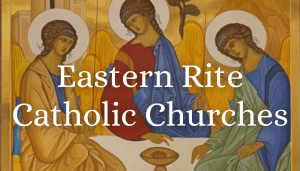
The universal Catholic Church is comprised of 24 ritual Churches. The largest by far, is our ritual Church, the Latin Rite Church—commonly referred to as the Roman Catholic Church. The other 23 Churches are together referred to as the Eastern Churches. They each have their own “liturgical rites, ecclesiastical traditions and their ordering of the Christian life.” (Decree on the Catholic Eastern Churches, no. 1) For example, St. George Church in Bay City is a Byzantine Catholic Church. Their eparchy is based in Parma, Ohio, and their bishop is The Most Reverend Robert Pipta. The Flint area has Byzantine, Maronite, Chaldean, and Ukrainian Rite Catholic Churches. There are a number of Eastern Catholic Churches in the Detroit area as well.
“Between those churches there is such wonderful communion that this variety, so far from diminishing the Church’s unity, rather serves to emphasize it.” (Decree on the Catholic Eastern Churches, no. 2)
These Eastern Rite Catholic Churches are in full communion with Latin Rite Catholics, although their practice of the Catholic faith might look quite different than our Western practices. “The holy Catholic Church, which is the Mystical Body of Christ, is made up of the faithful who are organically unified in the Holy Spirit by the same faith, the same sacraments and the same government. They combine into different groups, which are held together by their hierarchy, and so form particular churches or rites. Between those churches there is such wonderful communion that this variety, so far from diminishing the Church’s unity, rather serves to emphasize it.” (Decree on the Catholic Eastern Churches, no. 2) All of these 24 ritual churches “are none the less all equally entrusted to the pastoral guidance of the Roman Pontiff [the Pope], who by God’s appointment is successor to Blessed Peter in primacy over the Universal Church.” (Decree on the Catholic Eastern Churches, no. 3)
Within this unity, there have organically grown various liturgical traditions. For example, although the Eucharistic liturgy celebrated at St. George Byzantine Church in Bay City is recognizable to us in its basic structure, it is called The Divine Liturgy of St. John Chrysostom (5th Century Archbishop of Constantinople), although for some major feast days The Divine Liturgy of St. Basil the Great (4th century bishop) is celebrated. These liturgies grew out of the Greek language and the culture of Asia Minor—modern-day Turkey), whereas the Eucharistic liturgy as celebrated here at Assumption Parish has grown out of the Latin language and the culture of Western Europe. Another liturgical tradition in the Eastern Catholic Churches is that the Sacraments are referred to as the Holy Mysteries. Infants receive all three Mysteries of Initiation (Baptism, Chrismation—what Latin Rite Catholics refer to as Confirmation—and Eucharist) at once, where in the Latin Rite Church these Sacraments are received separately over time when a child is baptized before the age of reason (around age 7 or 8).
The Eastern theological emphasis on the cosmic importance of Jesus’ Paschal Mystery is a balance to the Western emphasis on personal salvation in Christ.
The Eastern Churches also have developed somewhat different theological emphases than the Latin Rite over time. Two examples of this are the Eastern emphasis on theosis and its emphasis on the cosmic importance of Jesus’ saving Cross and Resurrection, which inaugurated a New Creation (2 Peter 3:13, Revelation 21:1-5). Theosis refers to the mystery that our redemption in Jesus is not just heeding his wise teachings and following his example, or even that our sins have been forgiven through the sacrifice of his Cross, but also that we have been given the grace of divinization (a likeness to God, share in God’s own eternal life) through the gift of the Holy Spirit. As the Eastern Father of the Church St. Athanasius said, “the Son of God became human so that we might become God.” (Catechism of the Catholic Church, no. 460) The Eastern theological emphasis on the cosmic importance of Jesus’ Paschal Mystery is a balance to the Western emphasis on personal salvation in Christ. While it is true that each of us is personally saved through the Cross and Resurrection of Christ, that is because we are a part of the whole of creation that has been wounded by sin and is being transfigured and renewed through Jesus’ Resurrection.
Vatican II emphasized the important role that the Eastern Catholic Churches can play “fostering the unity of all Christians, in particular the Eastern Christians” who are not in full communion with the Pope. (Decree on the Eastern Catholic Churches, no. 24) The Orthodox Churches, who were separated from the governance of the Roman Pontiff about a 1000 years ago, are very close to the heart of Catholics, and the Decree on the Eastern Catholic Churches of Vatican II sought to find new avenues for “mutual sharing in sacred things” to help heal divisions and bring us closer in full communion with each other as Christians. (Decree on the Catholic Eastern Churches, nos. 26-29)
The Eastern Catholic Churches were very close to the heart of Pope St. John Paul II because of his Eastern European/Polish heritage, making him a “son of a Slav people.” (The Light of the East, no. 3) He famously wrote that the Eastern and Western Churches are the two lungs of the Church, and that when we work together in harmony the message of the Gospel can be better proclaimed to all people. May we as a parish enrich our Latin Rite spirituality with the insights to be gained from the theological and liturgical emphases of the Eastern Churches so that we can better proclaim the Good News of Christ and bring about greater unity among all whom we are called to serve.
As we have explored the documents of Vatican II so far this summer, we’ve now concluded our reflections on the questions, “Who are we as a Church?” “How are we as Catholic Christians related to political authorities and non-Catholics?” and “How are Latin Rite Catholics and Eastern Rite Catholics related to each other?” Over the next few weeks, we will explore one last question in light of the questions that we have previously considered, “What is our mission as modern Catholics?” This upcoming week, we will begin our exploration of this question by reading the Vatican II document The Dogmatic Constitution on Divine Revelation (also known by its Latin title Dei verbum). Click here to read this document on the Vatican website.
John