Eternal Life Starts Here and Now
By John Graveline, Director of Parish Life
April 5, 2026
“Jesus said to them, ‘I came that they may have life and have it abundantly.’”
John 10:10
The Immaterial Miracle of Life
Easter is the celebration of new and abundant life, a new creation; but what kind of life are we celebrating?
Life on earth is a miracle. Once, when exploring the Badlands, naturalist, as he recounted in his book The Immense Journey, Loren Eiseley noted the fossilized ground he traversed. “The shearing molars of dead titanotheres, the delicate sabers of soft-stepping cats, the hollow sockets that held the eyes of many a strange, outmoded beast,” composed of a combination of carbon, iron, calcium, and phosphorous. Then, overhead, a “wild flight of south-bound warblers hurtled over me into the oncoming dark. There went phosphorus, there went iron, there went carbon, there beat the calcium in those hurrying wings. Alone on a dead planet, I watched that incredible miracle speeding past.” The same elements and chemicals were present both in the dead fossils and soil and the vibrant birds. What was the difference? Science alone cannot discern what makes these chemicals alive here and those same chemicals not alive there? The answer lies in the immaterial miracle of life, what we have come to call soul. When we have eyes open to this miracle of life, we see that all life (plant, animal, and human) is a good and wondrous gift, teeming with abundance.
Everlasting Bliss or Eternal Life?
However, we sense that all is not well. While life is abundant, it is not infinite. It has limits. When I say yes to this good thing, I am simultaneously saying no the possibility of other good things. When I give you my undivided attention, I necessarily cannot give anyone else my undivided attention. Over and over again, we run into (and are often frustrated by) the limitations of life. There is only so much time, so much energy, so much material wealth. The ultimate limit to life is death. Our time in this earthly life is finite. It will end. Thereupon, the chemicals that comprise our bodies will lose their vital tension and dissipate. Coming to this stark realization, some people come to see life itself as absurd and lose the will to live. However, we sense in our rebellion against the limitations of life, especially the ultimate limitation of death, evidence that we are meant for more. We believe that some essential element of our existence, our souls, are immortal. The soul lives on forever even after the death of the body.
While this truth may be comforting, it is not itself free from problems. What does life after death look like, feel like? Can life without a body ever be properly called human? How can we find out? Is there pain and suffering on the other side of death? Is there hatred and violence? Is there peace and love? If our immortal souls after death are united with God the loving creator, sustained, and ground of all existence, then what bliss! But if our immortal souls after death are alienated from that good God, everlasting life is the ultimate curse! As Catholics, isn’t it our belief that the meaning of the life, death, and resurrection of Jesus Christ that he has saved our souls so that they can participate in the blessedness of Heaven? Absolutely, for “by his death and resurrection, Jesus Christ has ‘opened’ heaven to us. The life of the blessed consists in the full and perfect possession of the fruits of the redemption accomplished by Christ.” (Catechism of the Catholic Church, no. 1026)
But through the Paschal Mystery of Jesus’ death and resurrection, God offers us something much better than everlasting bliss. God offers us a share in God’s own eternal life through Baptism and the other Sacraments. The Catechism of the Catholic Church states it this way, “The Word became flesh to make us ‘partakers of the divine nature’ (2 Peter 1:4) For this is why the Word became man . . . so that we, by entering into communion with the Word and thus receiving divine sonship, might become a child of God. For the Son of God became man so that we might become God.” (no. 460) Theologian Romano Guardini in his book The Lord explains it this way, “eternal life has nothing to do with the length of that life; it is not the opposite of transitory life. Perhaps we come closest to the truth when we define it as life which participates in the life of God . . . this eternal life does not wait until after death to begin. It already exists. The essence of Christian consciousness is founded on its presence—through faith.” Eternal life, the absolute, infinite, abundant life that Jesus says is the reason that he became one of us, is present to us right here and now if we open ourselves to this mystery in faith and approach the Sacraments, especially Holy Communion as frequently as possible. “Jesus said to them, ‘Very truly, I tell you, unless you eat the flesh of the Son of Man and drink his blood, you have no life in you. Those who eat my flesh and drink my blood have eternal life, and I will raise them up on the last day; for my flesh is true food and my blood is true drink. Those who eat my flesh and drink my blood abide in me, and I in them. Just as the living Father sent me, and I live because of the Father, so whoever eats me will live because of me.’” (John 6:53-57)
“May the God of peace himself sanctify you entirely; and may your spirit and soul and body be kept sound and blameless at the coming of our Lord Jesus Christ. The one who calls you is faithful, and he will do this.”
1 Thessalonians 5:23-24
The Meaning of Easter
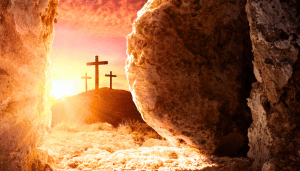
This offer of Eternal Life through the death and resurrection of Jesus is the meaning of Easter, is the Life—the New Creation—that we celebrate today. To gratefully open our minds and hearts to receive this gift, to allow this gift of Eternal Life to grow and transform us, to share this gift with everyone we meet is salvation, for our entire persons—spirits, souls, and bodies—for our entire world and for the entire cosmos.
John