God’s Word and the Work of Unity
By John Graveline, Director of Parish Life
January 25, 2026
“[Jesus prayed] ‘I do not pray for them alone. I pray also for those who will believe in me through their word, that all may be one as you Father, are in me, and I in you; I pray that they may be one in us, that the world may believe that you sent me.’”
John 17:20-21
One Body, One Spirit
This Sunday marks the conclusion of the 2026 Week of Prayer for Christian Unity. Pope Leo in his address at the beginning of the week invited “all Catholic communities to deepen their prayers for the full, visible unity of all Christians.” As St. John presents it in his Gospel, at his Last Supper on the night before he died on the cross, Jesus’ main prayer was for unity among his believers. St. Paul echoes this message in his writings as well, “Make every effort to preserve the unity which has the Spirit as its origin and peace as its binding force. There is but one body and one Spirit, just as there is but one hope given all of you by your call. There is one Lord, one faith, one baptism; one God and Father of all, who is over all, and works through all, and is in all.” (Ephesians 4:3-6) Unity has been an emphasis of the pastoral leadership of Bishop Gruss, calling the entire Diocese of Saginaw to be “of one heart and one mind.” (Acts 4:32)
Centrality of the Scriptures
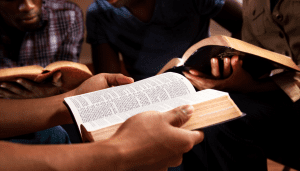
This Sunday is also the Sunday of the Word of God as established by Pope Francis in 2019 to be celebrated every year on the 3rd Sunday in Ordi nary Time. As Catholics, we recall the centrality of the Scriptures to our faith. We enthrone the Bible in sanctuary and reflect upon the meaning of the Word of God in our lives.
For many years after the Protestant Reformation, the Bible had become a sign of division between Catholics and Protestants. Although never the official teaching of the Catholic Church, many Catholics viewed reading the Bible as “something Protestants do,” something to be looked upon with suspicion. Therefore, Catholic homes tended to have a large, dusty “family Bible” where important family dates (baptisms, First Communions, weddings, deaths) were recorded, but no one ever picked up the Bible and read it. In the 60 years since Vatican II, Catholics have become much more comfortable listening to the Scripture readings in their own language in the liturgy and reading the Bible themselves or in small groups (often with an ecumenical mix of Catholics and Protestants). This is a very healthy fruit of Vatican II, and we pray that this renewed emphasis on the Word of God will be part of God’s reconciling work of unity between all Christians.
Three Reasons to Take Up the Bible
I would like to propose three reasons to make the Bible a central part of your spiritual practice: First, we become wise through familiarity with the Scriptures. One aspect of this is that knowledge of the Bible will help one understand the artistic and literary expressions of Western civilization. So much of the humanities become more intelligible when our minds have been steeped in the Old and New Testaments. On a deeper level, the Bible expresses to us the mind and heart of God. A definition of wisdom that I have found helpful is, “true wisdom is learning to see all of reality the way that God sees it.” If this is true, then there is no better place to learn how God views reality than through the writings that God inspired for the sake of fostering an encounter of interpersonal communion with us. Intimate communion in any relationship often hinges upon learning to look together with a common vision. When we listen to the Scriptures, God is inviting us to look at everything through the eyes of our loving Father.
Second, we encounter the “Word” (John 1:1, 14) through listening to the words of Sacred Scripture. The Catechism of the Catholic Church reminds us that Christianity is not “a religion of the book;” it is “the religion of the Word of God, a Word which is not a written and mute word, but the Word which is incarnate and living.” (no. 108) While this might seem to contradict the importance of the Bible, in fact it raises its importance because every other book expresses the thoughts of its author, but the Bible expresses the living person of Jesus Christ, the Word made flesh in order to offer us a share in his own divine life. It reminds us that when we listen to the words of Scripture, we encounter the voice of the Word who offers us abundant, eternal life.
Third, our lives can be transformed through familiarity with the living and effective Word. (Hebrews 4:12) The Word of God has the power to change us. The same Holy Spirit that was poured into our hearts at baptism is the Holy Spirit who inspired the scriptures. When we truly listen to God’s Word, the Holy Spirit dwelling in us dialogues with the inspiring Holy Spirit. Through the human words of scripture, we enter into the mystery of the Spirit which transcends all human words and expression. As stated by the 20th century French theologian Yves Congar, whose thought was very influential both before and after Vatican II, “the divine Scriptures are regarded as a kind of sacrament: a grace-bearing sign that effectively realizes communion with God,” a communion that can transform our hearts and minds, raising us to greater heights of virtue, holiness, and love.
May this Sunday of the Word of God bear fruit. May a deep listening and heeding the words of Sacred Scripture guide us into deeper communion with ourselves and God and between ourselves and all God’s people, bringing about the unity the Jesus prayed for on the night before he died to reconcile us to one another and to the Father in the Holy Spirit.
John