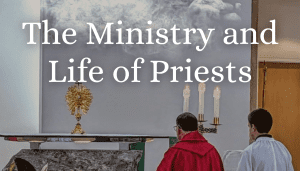
Presbyterorum Ordinis: The Ministry and Life of Priests
By John Graveline, Director of Parish Life
June 7, 2026
“Jesus said to the crowd, ‘I am the living bread that came down from heaven; whoever eats this bread will live forever; and the bread that I will give is my flesh for the life of the world . . . Whoever eats my flesh and drinks my blood has eternal life.’”
John 6:51, 54
This weekend, we celebrate the Solemnity of the Most Holy Body and Blood of Christ (Corpus Christi). Vatican II’s Dogmatic Constitution on the Church (Lumen Gentium), which we considered a couple of weeks ago, famously stated that the celebration of the Eucharistic sacrifice is “the source and summit of the Christian life . . . strengthened by the body of Christ in the eucharistic communion, [the Church] manifests in a concrete way the unity of the People of God which this holy sacrament aptly signifies and admirably realizes.” (no. 11) Furthermore, this week’s Vatican II document, Decree on the Ministry and Life of Priests (Presbyterorum ordinis), expands on this line of thought, “But the other sacraments, and indeed all ecclesiastical ministries and works of apostolate are bound up with the Eucharist and are directed toward it. For in the most blessed Eucharist is contained the whole spiritual good of the Church, namely Christ himself our Pasch and the living bread which gives life to all people through his flesh—that flesh which is given life and gives life through the Holy Spirit.” (no. 5) Full participation in the Eucharist is at the heart of a life of Christian discipleship. It is the primary “place” of our Communion with Jesus, and through him with the Father and the Holy Spirit, making us holy and empowering us to bring the healing light and peace of Christ into our wounded world.
“Jesus performs a miracle every time you receive the Eucharist, which is His real Body and Blood and not just your imagination. It’s Jesus’ connection with you.”
As part of our participation in the Year of the Holy Spirit, opportunities will be given in all the contexts of parish life to give personal witness and testimony to the good work God has done in your lives and the meaning of your Catholic faith. In this context, I would like to share with you a letter that moved me very much. Parishioner Joan Farkas wrote it to parishioner Marlene Saotome’s grandson who received his First Communion this Easter Season. I have asked Joan and Marlene if I could share it with you:
Dear [young disciple],
I am your grandma and grandpa’s friend Miss Joan. When your grandma told me you were making your first Communion, I was very excited. What a special day! When Jesus had his last meal with His apostles, who were His friends and the men He would give the job of spreading the new faith, He knew these men were the closest people He had, and they would soon take on a huge job for him.
During the Last Supper, Jesus took a piece of bread and he said: “Take and eat this Bread. It is my Body.” Jesus knew the apostles were confused and shaken by what He was saying and doing. They really did not understand how the bread was changed into Jesus’ Body. It was a miracle! The same miracle happened when YOU received the Eucharist. You really took in the Body of Christ. Then Jesus held the wine up to the apostles and said, “This is my Blood which is poured out for many for the forgiveness of sins.” The priest takes the chalice and says, “This is my Blood,” and the second miracle takes place for you: the wine turns into Jesus’ Blood.
The apostles were at a complete loss. They were reverent and knew that Jesus would never tell them something that wasn’t true. But just how did this happen? Jesus performs a miracle every time you receive the Eucharist, which is His real Body and Blood and not just your imagination. It’s Jesus’ connection with you. He gives you His Body and Blood and he desires your love and the promise that you will do all you can to show His love for you and for others through how you act towards others. You must be kind, be caring, be loving, and be helpful. That is how Jesus would act. But it’s not easy to be that way all the time. We have to ask Jesus to help us be like He is. At night, when you pray to Jesus about your day, ask for His help, even for specific things, not just general things. Jesus knows your whole life, everything you do and say. He knows when you are good and not so good. Ask for His help to improve the not-so-good times and to make the good times better.
Congratulations! Your First Communion is an important day. It’s a difficult concept to understand. Do the best you can. We all struggle, but the warm feeling you get from receiving Jesus is worth it.
Yours truly, Miss Joan
Thank you, Joan, for sharing your Eucharistic faith with us on this Solemnity of the Most Sacred Body and Blood of Jesus! Please keep Joan in your prayers as she continues her treatments. She is such an inspiration in our parish! As we reflect on the great gift of the Eucharist, I offer three suggestions:
- Make Saturday evening/Sunday Eucharist the priority in your life, especially over the summer. Schedule everything else around “the source and summit of the Christian life.”
- If you already participate in Mass every weekend, consider participating in Eucharistic worship part of your life between weekends. Are you able to participate in one of our weekday morning 8:00 a.m. Masses? On Wednesday evenings, beginning at 6:30, we have Mass followed by a time of quiet Eucharistic adoration. This is a life-changer.
- Consider offering a Mass intention through the parish office. “In this way the faithful unite themselves more intimately to Christ who offers Himself and are, in a certain sense, inserted even more deeply into communion with Him. This practice is not only approved by the Church but also promoted.” We generally don’t have many Mass intentions in our parish. I would love to see more people take advantage of this spiritual opportunity. Masses may be offered for the deceased, but also for the intentions of the living.
This upcoming week, we will continue to reflect on the question “Who are we as a Church?” by reading the Vatican II document The Decree on the Training of Priests. It’s also known by its Latin title Optatam totius. Click here to read this document on the Vatican website. Next week’s bulletin column will consider the life and ministry of priests before and after Vatican II.
John