Vatican II: A Guiding Star
By John Graveline, Director of Parish Life
May 17, 2026
“Then Jesus, filled with the power of the Spirit, returned to Galilee, and a report about him spread through all the surrounding country. He began to teach in their synagogues . . . He unrolled the scroll and found the place where it was written: ‘The Spirit of the Lord is upon me, because he has anointed me to bring good news to the poor. He has sent me to proclaim release to the captives and recovery of sight to the blind, to let the oppressed go free, to proclaim a year of the Lord’s favor.’”
-Luke 4:4-5,17-19
A Year of the Holy Spirit
Bishop Gruss has proclaimed the next year, from Pentecost 2026 through Pentecost 2027, as a Year of the Holy Spirit throughout the Diocese of Saginaw. In his letter of proclamation, he invited us to become “more missional focused . . . that ministry begins ‘with the power of the Holy Spirit.’” The bishop envisions “num-erous events in the Diocese and in particular parishes to celebrate the Year of the Holy Spirit.”
Vatican II: The Holy Spirit Speaks in Our Times
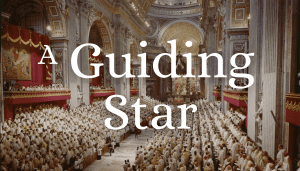
As one response to the bishop’s invitation, I would like to invite us as a parish to reflect over the summer on one of the main ways that the Holy Spirit has spoken through our church in modern times. Beginning this past January, Pope Leo began a series of teachings each Wednesday on the topic of Vatican II, helping us to better listen and heed how the Holy Spirit has spoken to us in our times. The pope stated that he is sharing these reflections as “a valuable opportunity to rediscover the beauty and importance” of the documents of Vatican II, which are still “a guiding principle for us today . . . the guiding star of the Church’s journey today.”
What is Vatican II? Vatican II was an ecumenical council (worldwide meeting of bishops and other guests) which was called together at the Vatican in 1962 by Pope St. John XXIII. When he opened the council, Pope John prayed to the Holy Spirit to “renew your wonders in our day as by a new Pentecost.” This was an unexpected move by the Holy Father, since Vatican II was only the second ecumenical council since the mid-16th century and the first in almost 100 years. The council was concluded by Pope St. Paul VI in 1965. Vatican II produced 16 documents, which have shaped the life of Catholics and other Christians over the past 60 yrs.
Why was Vatican II convoked at that time by Pope John XXIII?
Almost all the over 20 ecumenical councils in history were called to settle disputes of Christian doctrine in the face of unorthodox teachings (heresies) being spread that threatened the unity of the Church’s faith and practice. The First Vatican Council (1869-1870) was called because of the political reality of the dissolution of the Papal States in Italy, which was putting to an end the era where the Pope ruled the governing of both the Church and the state. It defined the Pope’s unique role in the Church, even as the papacy was losing its influence in the political sphere.
The Second Vatican Council was different. It was not a doctrinal council, but a pastoral council. The first half of the 20th century had been the most violent and destructive in history. The great advances in technology, while solving many problems that had plagued humanity throughout history, had also been turned against humanity. The bloodshed and devastation of the two World Wars (mostly between Christian nations!), the unimaginable evil of the Jewish Holocaust and other ethnic/national genocides, the rise of a kind of Atheistic nationalism (Communism, Nazism) that justified the denial of human dignity and human rights, the detonation of nuclear weapons upon Japan and their subsequent proliferation, etc. put the world on the brink of annihilation. Human life had never been violated so casually. In this context, a Catholic Church taking its direction from the Council of Trent (16th century-concerned with the challenge of the Protestant Reformation) would be inadequate to the new situation in which humanity found itself in the mid-20th century. Put simply, the Lutherans (and other Protestants) were not the problem. The entire world had lost its sense of God (as the philosopher Nietzsche ruefully observed that “God is dead” in the modern world). When humans lose faith in the reality of the Living God, we lose the sense that we are all related as sisters and brothers in the Father’s love and that we are all created in the image of the God who is Love. Thus, others become means or obstacles to fulfil our desires, leaving violence and death as means to attain this end.
Ressourcement and Aggiornamento
Vatican II walked two complimentary paths to address the threats to the very existence of humanity and our common home that marked the mid-20th century (and still mark our times). One was the path of ressourcement. The other was the path of aggiornamento. Ressourcement is a French term meaning “return to the sources.” The bishops at Vatican II recognized that our times are more like the times that the early Christians experienced under the paganism of the Roman Empire than they resembled the “Christ-endom” that characterized Europe of the 2nd millennium. Vatican II called us back to the roots of our tradition, roots that take account of the entirety of Christian history not just the tradition that arose out of the Catholic counter-Reformation. A renewed Church able to meet modern challenges must take inspiration from the entire tradition. Aggiornamento is an Italian word that means “adaptation and updating.” A Church that seeks to be fruitful must speak to modern people in ways that we can understand. It must not only look back into the tradition but also forward toward the unique situation of our times, speaking to people’s real needs and concerns. Christians in our times cannot withdraw from the concerns of modern people and the political and moral realities that we face together but engage those realities under the guidance of the Holy Spirit. The model for aggiornamento is the Incarnation of Jesus, when the eternal Son of God became human (assuming but not absorbing human nature) and encountered the people and situational realities of his place and time, transforming them from within not through violence or coercion, but through love.
Read Along with Us
One way that I would like to invite us to follow the promptings of Pope Leo and Bishop Gruss is by prayerfully reading (or rereading) the documents of Vatican II over the summer. I will be doing this as a spiritual practice myself. Each week between now and the end of summer, I will reflect on an aspect or two of each document that might be relevant to our personal and communal journey at the beginning of this Year of the Holy Spirit. The documents can be found on the Vatican website. Thematically, I have organized the documents into the categories: (1) Who we are as a Church [May and June], (2) How we are related to other believers [July], and (3) What is our mission? [August].
This week, I would propose that we reflect on the Vatican II document The Dogmatic Constitution on the Church. It’s also known by its Latin title Lumen Gentium. Click here to read this document on the Vatican website. I hope that we can journey together with the pope and our bishop, following this “guiding star of the Church’s journey today” as we heed and discern the Holy Spirit’s promptings both personally and as a community of faith.
John