Christus Dominus: The Pastoral Office of Bishops
By John Graveline, Director of Parish Life
June 21, 2026
“The bishop as God’s steward must be blameless. He may not be self-willed or arrogant, a drunkard, a violent or greedy man. He should, on the contrary, be hospitable and a lover of goodness; steady, just, holy, and self-controlled. In his teaching he must hold fast to the authentic message, so that he will be able to both encourage all to follow sound doctrine and to refute those who contradict it.”
Titus 1:7-9
As we continue to reflect upon the documents of Vatican II at the beginning of the Year of the Holy Spirit, this week we explore The Decree on the Pastoral Office of Bishops in the Church (also known by its Latin title Christus Dominus). This Decree is best considered in light of Chapter III (“The Church is Hierarchical”) of The Dogmatic Constitution on the Church which we read a few weeks ago.
The office of bishop was established by Jesus when he gave his apostles the gift of the Holy Spirit and sent them out on mission to the ends of the earth to spread the Kingdom of God. (John 20:21-22, Acts 1:2,8) This ministry continues through the bishops of our times through the Sacrament of Holy Orders. “The bishops have been designated by the Holy Spirit to take the place of the apostles as pastors of souls and, together with the Supreme Pontiff and subject to his authority, they are commissioned to perpetuate the work of Christ, the eternal Pastor.” (Decree on the Pastoral Office of Bishop in the Church, no. 2) So for us, Bishop Gruss is our connection to the apostles’ mission and authority, which was given to them by Christ.
“[A] sacred character is impressed in such wise that bishops, in a resplendent and visible manner, take the place of Christ himself, teacher, shepherd, and priest, and act as his representatives.” (Constitution on the Church, no. 21)
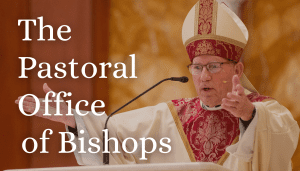
Bishops are usually assigned a prescribed section of the People of God over which they minister. These have come to be known over time as dioceses. In his own diocese, the bishop has the primary office of teaching, leading, and sanctifying the faithful. At our baptism, we are all anointed in Jesus the Priest, Prophet, and King. However, when bishops receive the fullness of the Sacrament of Holy Orders “through the words of consecration, the grace of the Holy Spirit . . . a sacred character is impressed in such wise that bishops, in a resplendent and visible manner, take the place of Christ himself, teacher, shepherd, and priest, and act as his representatives.” (Constitution on the Church, no. 21) Therefore, the mission of preaching and catechesis, of church governance, and of facilitating the spiritual, liturgical, and sacramental life of the local church is first of all the responsibility of the diocesan bishop.
To assist bishops in carrying out this great responsibility, they have the assistance of cooperators in their pastoral ministry. In every diocese, a bishop’s main cooperators are the priests and deacons who have received the Sacrament of Holy Orders in order to minister and serve God’s people. In some larger dioceses, auxiliary bishops are ordained to help the (arch)bishop pastor a large (arch)diocese. The bishop also has a curia office. In the Saginaw Diocese, Fr. Bill Rutkowski serves the bishop administratively as Vicar General and Moderator of the Curia and Fr. Alberto Vargas serves as Judicial Vicar and Chancellor, overseeing the application of the Church’s canon law. The diocese also has many offices that guide the ministries of the local church, with many priests, religious, and lay people employed to enact the bishop’s vision for the diocese and to assist and train parishes for their pastoral work. Furthermore, we are fortunate in the Diocese of Saginaw to have Lay Ecclesial Ministers who have received excellent formation and are commissioned by the bishop to serve the Diocese of Saginaw and its parishes, a number of whom serve here at Assumption Parish. These ministries are supported financially by the annual Christ’s Mission Appeal.
While each bishop has a responsibility and authority over his own diocese, all of the bishops together comprise a college of bishops, who share a responsibility for the entire Church, under the leadership of the Pope.
Bishops are not just ordained for ministry within their own diocese, but also to serve the common good of the entire Church. “It is often impossible, nowadays especially, for bishops to exercise their office suitably and fruitfully unless they establish closer understanding and cooperation with other bishops . . . it would be in the highest degree helpful if in all parts of the world the bishops of each country or region would meet regularly, so that by sharing their wisdom and experience and exchanging views they may jointly formulate a program for the common good of the church.” (Decree on the Pastoral Office of Bishop in the Church, no. 37) While each bishop has a responsibility and authority over his own diocese, all of the bishops together comprise a college of bishops, who share a responsibility for the entire Church, under the leadership of the Pope. This collegiality is primarily seen in an ecumenical council, such as Vatican II, where all the bishops of the world are convened to give direction to the Church or to answer disputed questions. The college of bishops also meets periodically for various synods to assist the Pope in discerning the direction of Church’s various pastoral initiatives. On the national level, bishops minister collegially through the United States Conference of Catholic Bishops (www. usccb.org). One recent act of collegiality was the bishop’s consecration of our country to the Sacred Heart of Jesus in anticipation of our nation’s 250th anniversary. Closer to home, we also have the Michigan Catholic Conference (www.micatholic.org). The MCC helps the parishes of the State of Michigan with coordination of insurance and employee benefits, among other services. It also has an advocacy arm that serves as the voice of the bishops of Michigan to legislators in Lansing, while also informing Catholics to the latest news of interest from the capitol. I highly recommend signing up for MCC Catholic Advocacy Network on their main webpage.
As you can see, the office of bishop carries great responsibilities. I encourage all of us to keep Bishop Gruss in our daily prayers. Since a great part of a bishop’s role to foster unity within his diocese, throughout the Church universal, and among all people; we will continue as a parish to listen to his guidance, implementing his diocesan pastoral plan inviting us to be a Diocese on Mission: supporting our priests and fostering vocations; forming intentional disciples to be sent on mission; and going forth to invite all people into a life-transforming relationship with Jesus in our community of faith.
This upcoming week, we will conclude our reflections on the question “Who are we as a Church?” by reading the Vatican II document The Decree on the Up-To-Date Renewal of Religious Life (also known by its Latin title Perfectae Caritatis). Click here to read this document on the Vatican website.
John