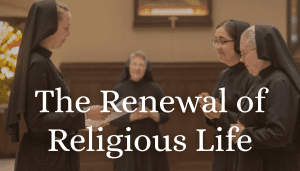
Perfectae Caritatis: The Renewal of Religious Life
By John Graveline, Director of Parish Life
June 28, 2026
“[Jesus said], ‘Do not be afraid, little flock, for it is your Father’s good pleasure to give you the kingdom. Sell your possessions and give alms. Make purses for yourselves that do not wear out, an unfailing treasure in heaven, where no thief comes near and no moth destroys. For where your treasure is, there your heart will be also.’”
Luke 12:32-34
As we continue to reflect upon the documents of Vatican II at the beginning of the Year of the Holy Spirit, this week we explore The Decree on the Up-To-Date Renewal of Religious Life (also known by its Latin title Perfectae Caritatis). This Decree is best considered in light of Chapter VI (“Religious”) of The Dogmatic Constitution on the Church which we read a few weeks ago.
First, let’s understand what we are referring to with the term Religious Life. Those in Religious Life in the Catholic Church are those who order their entire lives “to the following of Christ . . . and to their becoming united with God by the profession of the evangelical counsels.” (Decree on the Up-To-Date Renewal of Religious Life, no. 2) The evangelical counsels are vows made to God to freely live a life of poverty, chastity in celibacy, and obedience for the sake of the kingdom of God. They make these vows not because possessions, sex and family life, and power are bad. They choose to forego these goods in this life for the sake of something greater, the bringing about of the kingdom of God by binding themselves to the Lord Jesus, who “virginal and poor (Matt 8:20, Luke 9:58), redeemed and sanctified us by obedience unto death on the cross (Philippians 2:8). Under the impulse of love, which the Holy Spirit pours into their hearts (Romans 5:5), they live more and more for Christ and for his Body, the Church (Colossians 1:24).” (Decree on the Up-To-Date Renewal of Religious Life, no. 1) They are an example to all of us that we are not to live solely for this world and its goods, but for the life to come where there will be no possessions, procreation, or social hierarchies—the only thing that matters in Heaven is existence in communion with God’s undying love.
The Decree on the Up-To-Date Renewal of Religious Life is a good example of the twofold aim of Vatican II as a whole: ressourcement (“returning to the sources”) and aggiornamento (“updating and adaption”).
Examples of those who live Religious Life are religious sisters and brothers, such as Sr. Maria Bartos of the Bernardine Franciscan Sisters, who grew up in Assumption Parish. They often teach in Catholic schools or serve in missionary and/or charitable capacities. Some bishops and priests also live Religious Life, such as Fr. Dan Fox, pastor of Our Lady of Grace Parish in Sanford, who is a Capuchin Franciscan priest. Our last two popes have been religious priests. Pope Francis was a Jesuit priest, and Pope Leo is an Augustinian priest. The Decree on the Up-To-Date Renewal of Religious Life is a good example of the twofold aim of Vatican II as a whole: ressourcement (“returning to the sources”) and aggiornamento (“updating and adaption”). “The up-to-date renewal of the religious life comprises both a constant return to the sources of the whole of the Christian life and to the primitive inspiration of the institutes, and their adaptation to the changed conditions of our time.” (Decree on the Up-To-Date Renewal of Religious Life, no. 2) Every religious order or religious institute was asked to review the manner in which they lived and worked in light of their original founding vision and the modern circumstances in which Religious Life is observed and the people to whom they serve.
Besides the evangelical counsels, another way that Religious Life is a counter-cultural sign in our times is that it is usually lived in community. In our times when individualism and self-fulfillment are emphasized, the idea that fulfilment is found in community life is pretty radical. “Common life, in prayer and the sharing of the same spirit (Acts 2:42), should be constant, after the example of the early church, in which the company of believers were of one heart and soul . . . Religious, as members of Christ, should live together . . . carrying one another’s burdens (Gal 6:12). A community gathered together as a true family in the Lord’s name enjoys his presence (Matt 18:20), through the love of God. (Decree on the Up-To-Date Renewal of Religious Life, no. 15) Religious life is a sign to all of us that the Christian life cannot be lived as isolated individuals. That is why staying connected to community through parish life, especially the liturgy and Eucharist, is vitally important for our discipleship.
Far from contradicting each other, each [religious order] brought something distinctive to contribute to the mosaic of Christian life, enriching the entire Church.
The varieties of Religious Life in the Church are a wonderful example of unity in diversity. The vocation to follow Jesus in holiness is one for all the baptized. However, there are many diverse spiritualities and ministries in which that one call is concretely lived. (Ephesians 4:1-16) The various founders of religious orders across the globe and in every period of Christian history each had unique insights into spirituality, community life, and apostolate. Far from contradicting each other, each brought something distinctive to contribute to the mosaic of Christian life, enriching the entire Church. There is also a great diversity of work accomplished in religious life. For years, Religious sisters taught in Catholic schools and universities and founded Catholic hospitals. Cloistered nuns dedicate their entire lives to a life of prayer apart from the world for the sake of the fruitfulness of Church ministries and apostolates. Some Religious sisters serve in secular jobs. Sr. Mary Lisa Renfer, a member of the Sisters of Mercy of Alma and the sister of our Director Music and Liturgy Jim Renfer, is a medical doctor. When I was at the university parish at Grand Valley State, two Franciscan sisters were science professors at a state university.
The women and men who have given their lives completely to Christ and his Church through prayer, community, and the practice of the evangelical counsels bless the entire Church in innumerable ways. As a parish, let us take inspiration from their dedication to Christian discipleship; their centeredness on prayer, spirituality, and liturgy; their selfless service to all God’s people of every race, age, and belief; their commitment to living community life in unity and diversity; and their single-minded focus on seeking first the Kingdom of God, living this life to prepare for the next as we seek to grow together in our Christian discipleship during this Year of the Holy Spirit.
We have now concluded our reflections on the question “Who are we as a Church?” through reading the Vatican II documents on the Church, on the apostolate of lay people, on the roles of bishops and priests, and on religious life. We will now begin considering the question “How are we as Catholic Christians related to political authorities and non-Catholics?” This upcoming week, we’ll read the Vatican II document Declaration on Religious Liberty (also known by its Latin title Dignitatis Humanae). Click here to read this document on the Vatican website.
John