
Self-Reliance or Spirit-Reliance? The Gift of Counsel
By John Graveline, Director of Parish Life
October 11, 2026
“For lack of guidance a people falls; security lies in many counselors.”
Proverbs 11:14
This fall as we celebrate The Year of the Holy Spirit throughout the Diocese of Saginaw, we will explore each of the seven Gifts of the Holy Spirit that we received through Baptism and were fully activated in us through the Sacrament of Confirmation. By better understanding the meaning of these Gifts, we will be better able to put them to use in our journey of Christian discipleship.
The third of the Gifts of the Holy Spirit is the Gift of Counsel.
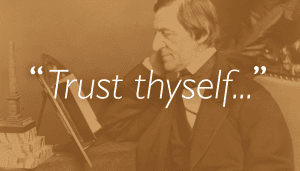
In 1841, the American Transcendentalist philosopher Ralph Waldo Emerson published one of the most influential essays in American history. Entitled Self-Reliance, the essay sought to provide a foundation to individualism and nonconformity. Emerson wrote, “Nothing can bring you peace but yourself,” and “Trust thyself: every heart vibrates to that iron string.” Rugged individualism and self-reliance are central to American identity. From earliest ages we are praised to the extent that we learn “to do it for yourself.” People who seek public assistance are often accused of becoming “dependent on the state.” One of the greatest fears of growing older is expressed, “I don’t want to become dependent on anyone.” Emerson’s essay, and individualism generally, does have its critics. The 19th century French social commentator Alexis de Tocqueville in his book Democracy in America wrote that individualism, “in the long run attacks and destroys all [public virtues] and is at length absorbed in downright egotism.” In our times, Mark Cladis of Brown University critiques individualistic self-reliance by pointing out that “we are surrounded by helps and aids of all kinds, supporting us, sustaining us, journeying always with us.”
As with so many things, Catholics see the value of both the individual and society. We are neither pure individualists nor socialists.
While competence and personal responsibility, which enable us to provide for ourselves and our loved ones, are undeniably good things, we as Catholics also see the indispensable value of society as well, which allows individuals to flourish. “The human person needs to live in society. Society is not an extraneous addition but a requirement of our nature. Through the exchange with others, mutual service, and dialogue we develop our potential and respond to our vocation.” (Catechism of the Catholic Church, no. 1879) As with so many things, Catholics see the value of both the individual and society. We are neither pure individualists nor socialists.
Jesus also saw the value in each disciple whom he called personally by name to follow him. He also gave us wise teachings in his sermons and parables. However, his main work during his public ministry was to establish the Kingdom by gathering together a community of disciples. “The seed and beginning of the Kingdom are the ‘little flock’ of those whom Jesus came to gather around him, the flock whose shepherd he is. They form Jesus’ true family.” (Catechism of the Catholic Church, no. 764) We have been reborn into the family of faith in order to assist each other to grow in our communion with God and neighbor in love. We have been redeemed in Christ “not as individuals without any bond or link between [us], but rather to make [us] into a people who might acknowledge him and serve him in holiness.” (Catechism of the Catholic Church, no. 781)
“[Jesus said,] ‘I will pray to the Father, and he will give you another Counselor, to be with you forever, the Spirit of Truth.’”
John 14:16
In the Gospel according to John, at his Last Supper Jesus promised his disciples “the Paraclete, the Holy Spirit, whom the Father will send in my name, will instruct you in everything, and remind you of all that I have told you.” (John 14:26) The Gift of Counsel is the realization of the assistance of the Holy Spirit, both directly in our hearts as well as through others in the Church, helping us discern the way of holiness and Christian discipleship. The Greek word Paraclete means “someone called to come alongside another person.” It is sometimes translated into English as “advocate” or “counselor.”
What does it mean that the Holy Spirit has been given to us through Baptism and Confirmation as our counselor? Probably because my brother is a lawyer, I like to think of the Holy Spirit as a divine lawyer (lawyers are formally referred to in court as “Counselor”).
Why would one hire a lawyer? Three reasons come to mind readily. First, lawyers have studied and know the law with more expertise than the average person. Who knows God’s law of love better than the Holy Spirit who is the Love between the Father and the Son who has discerned the very depths of God? (1 Corinthians 2:10-11) Second, lawyers provide objectivity for us because stress and personal emotions may cloud our judgment in court. The Holy Spirit in the voice of our consciences brings us objective clarity about God’s law and the circumstances in which our moral decisions are chosen. (John 16:6-13) Third, we need someone to advocate for us in court, to stand on our side. Even in our darkest hour, the Holy Spirit dwells within us, helping us in the midst of our weakness and bringing all things to our ultimate good. (Romans 8:26-28)
Wise people seek to lean on the understanding of the Holy Spirit, rather than self-reliance.
Ultimately, the Holy Spirit, the Counselor, aids us in our task of discernment of God’s plan in all things. Wise people seek to lean on the understanding of the Holy Spirit, rather than self-reliance. (Proverbs 3:5-6, Romans 12:2) Our fellow parishioner and diocesan Commissioned Lay Minister Noreen Warrick has led discernment formation sessions for our Pastoral Council. She shares this definition of discernment from the Diocese of Cleveland: “Discernment is a continual process of seeking, discovery, and awareness that involves intentional and focused listening with the heart, which leads us to collaborate with grace in living a life of holiness . . . discernment is a form of worship that must lead to Christian action in the world.” Sometimes, we can discern the voice of the Holy Spirit directly in our personal prayer. More often, discernment happens through dialogue in community: our family and friends; pastoral leaders, confessors, and spiritual directors; small prayer or study groups; professional counselors and support ministries such as our BeFriender Ministry. These relationships give us different insights and perspectives, opening our minds and hearts to the surprises of the Holy Spirit. Both Bishop Gruss’ diocesan advisory councils and our parish Pastoral Council are implementing processes of discernment instead of those of purely human decision-making. Thus, our path forward will not be mere activism, but a true gift received gratefully from the wisdom and understanding of the Holy Spirit.
May this Year of the Holy Spirit bring to life the Holy Spirit’s Gift of Council in us so that we can assist each other in more closely listening to the voice of the Holy Spirit in our hearts and in our parish family, implementing God’s vision for each of us personally and for our households, local community, nation, and world.
John